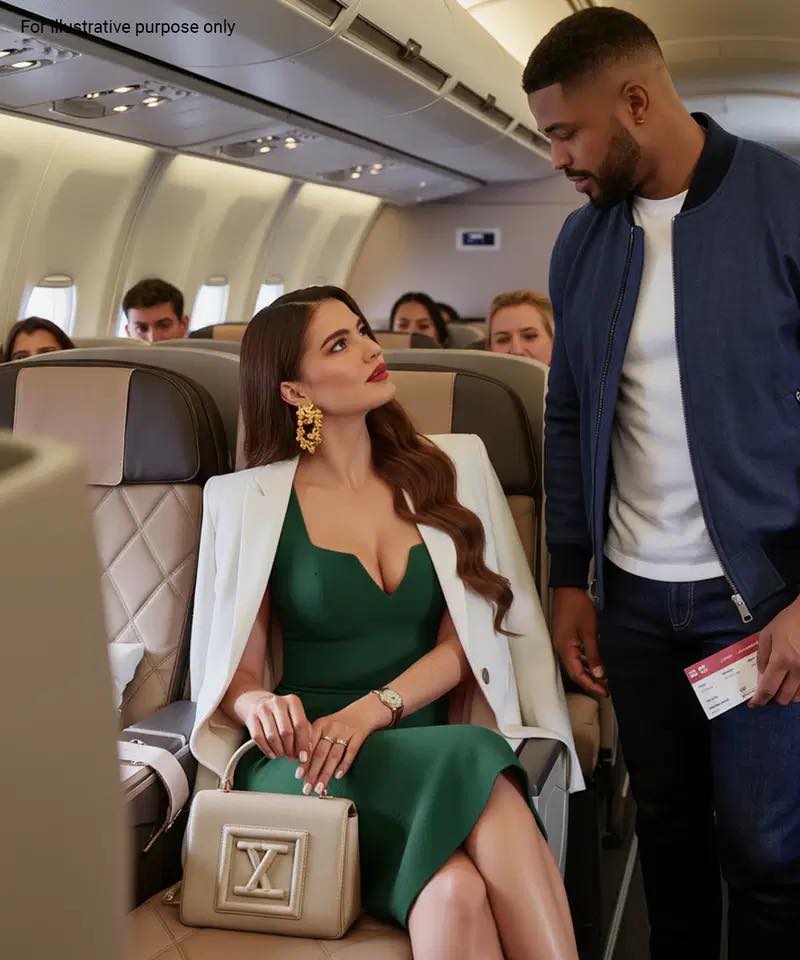
The crew was losing control of the narrative. Passengers were turning against them, and the phones kept recording.
“Look at him,” Karen said, standing from the seat and gesturing widely. “Use your eyes. Does anything about this man say ‘first-class passenger’ to you?” She pointed at Marcus’s hoodie. “That’s a $30 sweatshirt from a big-box store. I can tell.”
Marcus glanced down at his clothing, then back at Karen with mild curiosity. “How can you determine the price of my clothes?”
“Because I know quality when I see it,” Karen snapped. “Your shoes are probably discount. Your jeans look like they came from a warehouse bin.”
“Ma’am is absolutely right,” James nodded eagerly. “First-class passengers have certain presentation standards.”
Michelle crossed her arms. “We’re trained to identify passengers who might be out of place. It’s about maintaining the premium experience for legitimate customers.”
Marcus’s phone buzzed with notifications—text messages, missed calls, emails marked urgent. One message preview was visible: Board meeting moved to 4:00 p.m. Karen spotted it and laughed. “Oh, look. He’s got someone texting him about a board meeting. How cute.”
Several passengers shifted uncomfortably at the cruelty, but the crew seemed energized by Karen’s confidence.
“Sir,” David said, patience evaporated, “this is your final warning. Security is already on their way up the jet bridge.”
“Actually,” Marcus said quietly, “I’d like them to see this.”
His calm response seemed to unnerve the crew. They’d expected anger, arguments, threats of lawsuits. Instead, he stood there like he was collecting evidence.
“See what?” Sarah snapped. “Are you making a fool of yourself?”
“Him proving he doesn’t belong here?” Karen added with a laugh. “Look at him. Really look.”
A teenage passenger whispered loudly, “This is so wrong. They won’t even look at his ticket.”
James spun around. “Excuse me? We’re following standard protocols here.”
“Then why won’t you look at his ticket?” the teenager shot back.
“Because we can tell when someone’s not being truthful,” Michelle replied coolly. “It’s called experience.”
Marcus glanced down at his comfortable walking shoes, then back at Karen. Still no anger in his expression. If anything, he looked satisfied.
“Ma’am has a point,” Michelle said. “First-class passengers dress appropriately. They understand the environment they’re entering.”
“Exactly,” James nodded. “It’s about respect—respect for the airline, for other passengers, for the premium experience.”
Amy whispered to her live stream, “They won’t even look at his ticket.” Her viewer count hit twenty-five thousand. A trending tag on social media began to spike.
David keyed his radio again. “Security, what’s your ETA to gate A12?”
“Two minutes out,” came the crackling response.
“Perfect.” Karen clapped her hands together. “Finally, some professional handling of this situation.” She looked directly at Marcus. “I hope you’re happy with yourself. Now everyone on this plane knows exactly what kind of person you are.”
Marcus tilted his head slightly. “What kind of person am I?”
The question caught Karen off guard. She’d expected denial, not curiosity.
“You’re the kind who tries to take what isn’t yours,” she said, regaining her composure. “Who thinks you can fool people with papers and stories.”
“I haven’t told any stories,” Marcus observed quietly.
“Your whole presence here is a story,” Karen shot back. “A fantasy where you belong in first class. Well, reality is about to knock.”
The crew nodded in agreement. They’d created a unified narrative: Marcus was a problem; they were the guardians of order.
Heavy footsteps echoed from the jet bridge. Two airport security officers appeared at the aircraft door, radios crackling with status updates.
“There he is,” Sarah said, pointing at Marcus. “The passenger causing the disruption.”
Officer Williams, a Black man in his forties, approached with his partner, Officer Carter, an Asian American woman with kind eyes but firm demeanor—both in standard U.S. airport police uniforms. “What seems to be the problem here?” Officer Williams asked professionally.
David launched into his prepared explanation. “The passenger refuses to move to his assigned seat. Claims this first-class seat belongs to him despite obvious evidence to the contrary.”
“What obvious evidence?” Officer Carter asked.
The crew exchanged glances. They’d been so confident in their assumptions, they hadn’t considered someone might ask for actual proof.
“Well,” Sarah stammered. “I mean—look.”
Officer Williams’s expression hardened slightly. “Ma’am, I need specific evidence, not observations about appearance.”
Karen sensed the crew’s hesitation and jumped in. “Officers, I’ve been patient, but this man has been bothering me for ten minutes. I just want to sit in the seat I paid for.”
“Ma’am, we understand,” Officer Williams replied, then to Marcus: “Sir, your boarding pass, please.”
Marcus handed over the crumpled paper. Officer Carter examined it carefully, her brow furrowing as she read. The aircraft had gone almost silent except for the hum of electronics and whispered commentary from filming passengers. Officer Carter looked at the boarding pass again, then at Marcus, then at Karen sitting in 1A. Her expression shifted from professional neutrality to confusion.
This boarding pass says seat 1A,” she said slowly.
David stepped forward desperately. “Obviously forged. Look at him—”
“That’s not how we determine anything,” Officer Carter began, but Karen cut her off.
“Please, officer. Use common sense here. I’m a Diamond Medallion member. I’ve been loyal to Delta for fifteen years.” She pulled out her phone showing her Delta app. “Look, here’s my boarding pass. Seat 1A, first class.”
Officer Williams examined Karen’s phone, then looked back at Marcus’s paper boarding pass. The situation was becoming more complex than a simple seating dispute.
“Sir,” Officer Williams addressed Marcus, “can you show us some ID and explain how you obtained this boarding pass?”
Marcus reached slowly into his pocket, his movements deliberate and calm. The entire cabin watched as he withdrew his wallet, then shifted to his phone.
“Actually,” Marcus said, his voice carrying a new quality—quiet authority that made everyone lean in, “I think there’s something you all need to see first.”
The app on his phone finally loaded. The storm was moments from erupting. With smooth, deliberate motions, Marcus’s thumb navigated the screen. The Delta Air Lines interface morphed, unveiling hidden layers that typical passengers would never access: executive dashboard, CEO portal, internal employee controls. The display flooded with corporate intel, access credentials, and a title that made Officer Carter inhale sharply:
Marcus Washington, Chief Executive Officer. Authority Level: Executive. Employee ID: 0000001. Founder/CEO. Direct reports: 43,000 employees.
Officer Williams leaned over his partner’s shoulder to see the screen. His professional composure cracked for just a moment. “Sir,” he whispered.
The change in the security officers’ demeanor was immediate and unmistakable. They stepped back slightly, their posture shifting from enforcement to deference.
David noticed the officers’ reaction first. “What? What are you looking at?”
Marcus held the phone screen toward the purser. David’s eyes moved across the display, processing each word. His face went from confident authority to confusion to dawning horror in the span of three seconds.
“That—that can’t be.”
David’s clipboard slipped from his fingers, clattering to the floor.
Sarah leaned in to see what had shocked her supervisor into silence. When the information registered, her face drained of all color. “Oh my… oh my… oh my.”
James and Michelle leaned in, eyes narrowing at the screen. The chain of command was unmistakable. Everyone on the plane—from the captain down to the most junior flight attendant—ultimately answered to the man they’d been ignoring for the last ten minutes.
“Mr. Washington,” Officer Williams said quietly, voice carrying new respect, “we weren’t aware of your position.”
Marcus looked at the security officer with calm eyes. “Of course you weren’t. That was the point.”
The cabin had gone dead silent, except for the hum of electronics and the soft sound of phones recording. Every passenger sensed the dramatic shift in power, though most couldn’t see the phone screen.
Karen, still seated in 1A, looked around in confusion. “What’s everyone staring at? Can we please resolve this and take off?”
Marcus turned the phone screen toward her. Karen’s eyes scanned the display, her expression cycling through disbelief, recognition, and pure dread.
“You… you can’t be,” she whispered.
“I own sixty-seven percent of this airline, Ms. Whitmore,” Marcus said, voice calm but carrying unmistakable authority. “I don’t just have seat 1A. I’m responsible for every seat on this aircraft.”
The words hit Karen like a physical blow. She gripped the armrests of the seat—his seat—as the full magnitude of her situation became clear.
David found his voice, though it trembled. “Sir, we had no idea. We were just following—”
“Standard what?” Marcus interrupted gently. “Standard procedure is to examine passenger documentation before making assumptions. Standard procedure is to treat every customer with dignity and respect.” He looked at each crew member in turn. “Instead, you made judgments based on appearance. You refused to look at my boarding pass. You threatened me with removal.”
Sarah’s hands were shaking. “Mr. Washington, I’m so sorry. We made a terrible mistake.”
“You made several,” Marcus corrected. “But the biggest one was assuming that respect is earned by appearance rather than humanity.”
Amy’s livestream had surged to eighty-nine thousand viewers. The comment feed flew by in a blur, but the message was unmistakable: accountability was on its way.
Marcus glanced at his watch—not to check the flight schedule, but for something far more significant. His calendar displayed a series of alerts that drew audible gasps from nearby passengers who caught a glimpse: Emergency board meeting — Compliance Protocol Review, 4:00 p.m. Legal Department — Federal Report, 4:15 p.m. Media Relations — Press Conference Prep, 5:00 p.m. Current time: 3:47 p.m. Eastern.
Officer Carter realized what she was seeing. “Sir… this was planned.”
Marcus nodded slowly. “I’ve been conducting unannounced assessments of our passenger-experience protocols. Today’s test revealed failures at multiple levels.”
The crew stood frozen, understanding that they’d walked into a carefully orchestrated evaluation—and failed spectacularly.
Karen tried to stand from the seat, but her legs were unsteady. “I didn’t know. I had no idea.”
“Would it have mattered?” Marcus asked quietly. “If I were just Marcus Washington, passenger, instead of Marcus Washington, CEO, would that justify your behavior?”
The question hung in the air like an indictment. Karen had no answer because they both knew the truth.
“Ms. Whitmore,” Marcus continued, “you’re currently sitting in seat 1A, which is reserved for the chief executive officer when traveling. You’ve been occupying the CEO’s personal seat.”
Karen looked down at the leather as if it had suddenly become molten. Everything about her situation—her assumptions, her public behavior—crashed down on her at once.
David desperately tried to salvage his career. “Sir, if we could speak privately, I’m sure we can resolve this misunderstanding.”
“There’s no misunderstanding,” Marcus replied. “You and your crew treated a passenger differently based on appearance and perceived social class. That passenger happened to be your chief executive.”
He gestured to the cameras still recording. “There are dozens of witnesses, and it’s being broadcast live to a massive audience.”
Michelle found her voice. “Mr. Washington, please, we can fix this. We can make this right.”
Marcus looked at her with something that might have been pity. “Ms. Rodriguez, you threatened to have me removed for sitting in my own seat. How exactly do you propose to make this right?”
Marcus looked at her with something that might have been pity. “Ms. Rodriguez, you threatened to have me removed for sitting in my own seat. How exactly do you propose to make this right?”
The crew had no answer. They’d crossed lines that couldn’t be uncrossed, made assumptions that revealed their deepest biases, and done it all while being recorded.
Officer Williams cleared his throat. “Sir, what would you like us to do about this situation?”
Marcus considered the question. Around him, two hundred passengers waited to see how power would be wielded when the tables turned.
“Officer Williams, I’d like you and Officer Carter to witness what happens next. The documentation will be important for compliance.”
The words sent a shiver through everyone within earshot.
Marcus unlocked his phone again, this time pulling up his contacts. The names on the screen drained the last traces of hope from the crew’s faces: Legal Department — Direct Line. Human Resources — Emergency Protocol. Media Relations — Crisis Management. Board Chair — Immediate Response.
“Ladies and gentlemen,” Marcus announced to the cabin, voice carrying the authority of ownership, “I apologize for this delay. What you’ve witnessed today is exactly why systematic change is necessary in corporate America.” He looked at Karen, still frozen in his seat. “Ms. Whitmore, you have approximately thirty seconds to return to your actual assigned seat before I make the first of several phone calls.”
Karen’s expensive composure cracked completely. “Please, I’m sorry. I didn’t mean—”
“You meant every word,” Marcus said quietly. “The question now is what happens next.”
The entire cabin held its breath as accountability prepared to be served.
Marcus pressed the first number on his phone. The call connected immediately, broadcasting on speaker for the entire cabin to hear.
“Marcus Washington’s office, legal department. This is Patricia Hendris.”
“Patricia, this is Marcus. I’m currently on Flight 447, and I need you to prepare immediate documentation for a formal discrimination case review.”
Her voice sharpened with concern. “Sir, what’s the situation?”
“I’ve just been treated improperly by four of our own crew members and a passenger. The incident was captured on multiple devices and is currently being livestreamed to a large audience.”
Patricia’s silence lasted three seconds—an eternity in legal terms. “Sir, I’ll have a full legal team standing by within the hour. Are you injured?”
“Not physically, but our company’s reputation and compliance status are in serious jeopardy.” Marcus looked directly at David while speaking. “Employee number 47,291 just threatened to have me removed from my assigned seat. I’ll need his complete employment file and recommended actions prepared immediately.”
David’s face went ashen. Marcus knew his employee ID from memory.
“Mr. Washington,” David whispered desperately. “Please, I have a family. I have a mortgage. I was just following what I thought was protocol.”
“Protocol?” Marcus’s voice remained calm but carried steel. “Show me the protocol that says crew members should refuse to examine passenger boarding passes based on appearance.”
David had no answer because no such protocol existed.
“Patricia,” Marcus continued into the phone, “I also need comprehensive documentation on our current anti-bias policies. Clearly, they’re failing if our crew can’t distinguish between legitimate security concerns and profiling.”
“Should I contact the Federal Aviation Administration?” Patricia asked.
“Yes, and the Department of Transportation’s Office of Civil Rights. They’ll want to review our compliance immediately.”
The implications were mounting by the second. Federal agencies meant investigations, fines, and potential operational restrictions.
“Also prepare civil-rights documentation regarding public accommodations,” Marcus said.
He ended the call and immediately dialed the second number—human resources.
“Marcus Washington’s office, HR emergency line. This is Director Janet Mills.”
“Janet, this is Marcus. I need immediate employment actions reviewed for Flight 447 crew members.”
The cabin was dead silent except for the sound of phones recording and the soft crying from several crew members.
“Sarah Mitchell, employee 23,847,” he said. “Full investigation into violations. Six-month unpaid suspension pending mandatory training completion. She must pass an evaluation before reinstatement consideration.”
Sarah’s knees buckled. Six months without pay could mean losing her apartment, possibly her car.
“James Mitchell, employee 18,293. One-year probation with mandatory counseling sessions. Training certification required monthly. Any future incident results in immediate termination.”
James nodded frantically, grateful to still have employment.
“Michelle Patterson, employee 31,456. Mandatory intensive training program, professional evaluation, and demotion from senior flight attendant; salary reduction for two years.”
Michelle’s face crumpled. Fifteen years of career advancement threatened by ten minutes of poor judgment.
“And David Torres, employee 47,291,” Marcus said, voice carrying finality. “Immediate termination with cause.”
David collapsed, sobbing in the aircraft aisle. “Please, Mr. Washington, please don’t destroy my life. I made a mistake, but I can learn. I can change.”
“Mr. Torres, you had eight years to learn,” Marcus said. “Eight years of training and customer-service protocols. Instead, you threatened your own CEO with removal based on assumptions about me.”
He turned back to the phone. “Janet, implement immediate policy changes. Body-camera requirements for all crew interactions with passengers, effective tomorrow morning. Any complaint involving potential discrimination must be recorded and reviewed by a response team within twenty-four hours.”
“Budget allocation for the new program, sir?”
“Fifty million annually for the first three years. This systematic failure ends today.”
The number sent a shock wave through the listening passengers—money dedicated solely to preventing bias.
“Also establish a passenger-advocate position in every hub—independent oversight with direct reporting to my office—and create an anonymous reporting system with real-time alerts to management.”
“Sir, the operational changes will be significant.”
“The operational cost of discrimination is higher,” Marcus said. “We’ll also implement quarterly assessments for all customer-facing employees. Failure means immediate retraining or termination.”
Marcus ended the HR call and turned his attention to Karen, who was still sitting in his seat like she’d been turned to stone.
“Ms. Whitmore, now we discuss your situation.”
He pulled up her professional profile on his phone, turning the screen toward the recording camera so Amy’s 150,000 live stream viewers could see it clearly: Karen Whitmore, senior marketing director at a major beverage company; corporate diversity and inclusion committee, chairwoman; recent post: “Zero tolerance for workplace discrimination. We must all do better.”
The contrast was stark. A person who publicly championed inclusion had just committed one of the most blatant acts of bias many passengers had ever witnessed.
“Ms. Whitmore, you publicly advocate for inclusion while privately telling another passenger to leave a seat that wasn’t yours,” Marcus said quietly. “Your employer will find this interesting.”
Karen’s professional façade was disintegrating in real time. “Please, I didn’t mean— I’m not usually like this.”
“You meant every word,” Marcus said. “The question is, what happens next?” He pulled up his contacts again, showing a corporate executive relations direct line. “I can make one phone call and end your career today. Your company has a zero-tolerance policy for discrimination, don’t they?”
Karen nodded miserably.
“Or,” Marcus continued, “you can choose accountability over denial. You have two options.”
The entire cabin leaned forward. Accountability was about to be precisely measured.